The question
If both hands are occupied, what is left to command an extra robotic arm? The shoulders move freely and independently of the hands. This project asked whether muscle and inertial sensors around the shoulder girdle could drive a robot arm, first as a handful of discrete commands, then as continuous tracking, and whether that still works while the hands are doing something else.
What was built
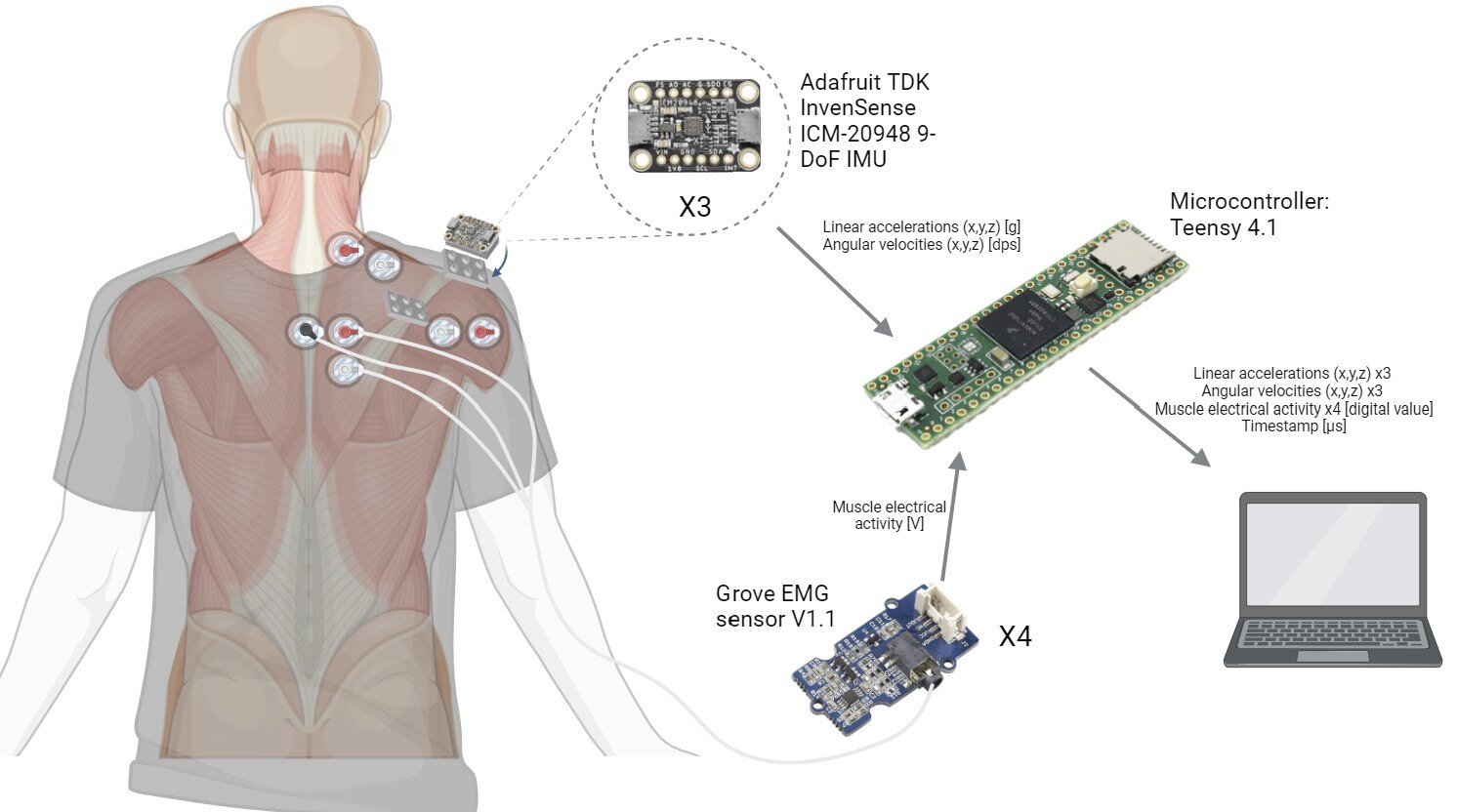
A sensing setup combining surface EMG over the shoulder muscles with inertial units, recorded from several participants performing shoulder positions and movements, alone and while carrying out a parallel writing task. A first model classified static shoulder positions for discrete control; a second used regression to follow continuous movement in real time on the arm.
What was found
Neutral, up, down and forward positions were recognised reliably, enough for discrete control in a plane; backward and sideways movements were harder, both to perform and to detect, and pointed to using more distinctive movements for those directions. Continuous tracking was feasible but suffered from session-to-session variability and delay. Controlling the arm while performing another task with the hands worked from a modelling point of view, provided the training data included that condition, though participants found the multitasking demanding. The work laid the groundwork for the strap-based command sensing that followed.