The question
A robotic limb worn on the body needs a command source that goes on and comes off with it, without an expert placing electrodes. Backpack straps carrying muscle and motion sensors over the shoulder girdle are a natural candidate. Two readouts were tested: the direction of an intended shoulder movement, and the shoulder's continuous angular velocity at the rate a control loop needs it.
What was built
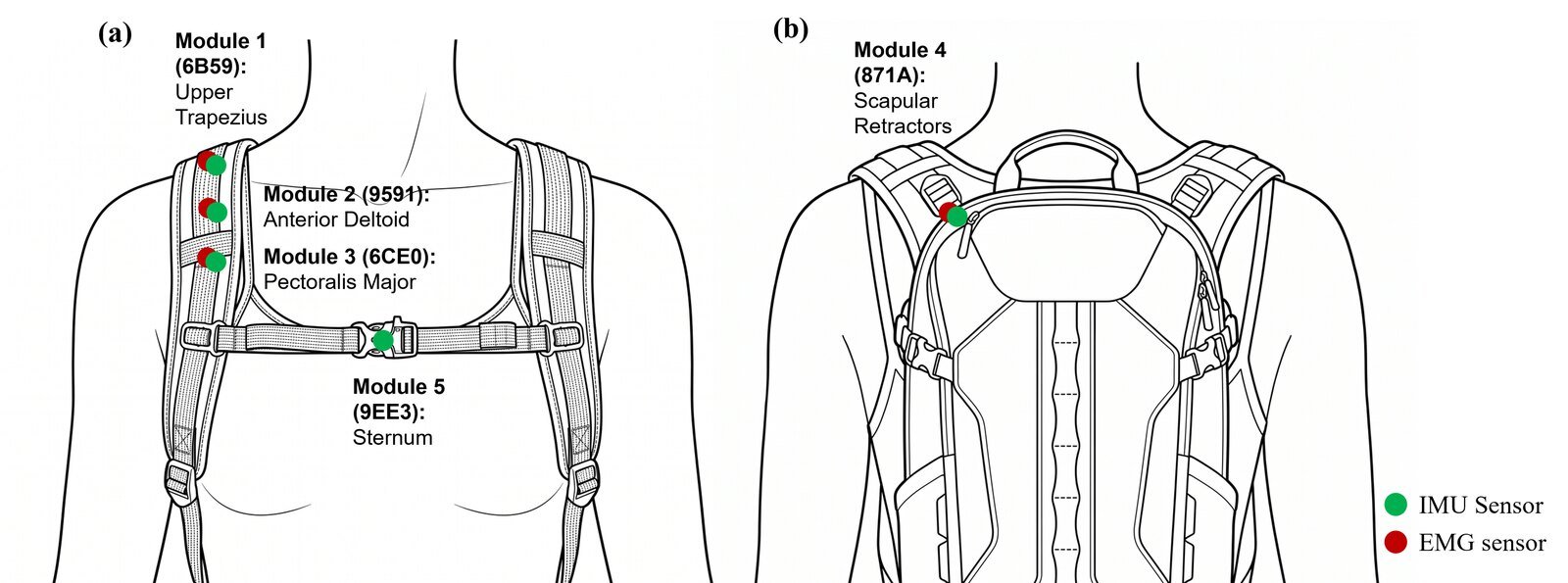
A compliant strap array with four muscle-sensing channels and inertial units over the shoulders and sternum, recorded on twelve participants across cued movements, deliberate electrode displacement, and closed-loop control of a simulated robotic arm. Decoders ranged from simple baselines to a temporal network with biomechanical constraints built into its training.
What was found
Direction works: six cued directions decode at 77 %, rising to 88 % once two pairs that the shoulders cannot physically separate are merged, and the result survives electrode displacement because it is driven by the inertial channels. Continuous velocity does not: no decoder beats simply holding the last measurement, because the target stops being predictable within about 80 ms while the controller asks every 100 ms. The limit belongs to the signal, not the model. The deliverable is a four-state shoulder command with a confidence-gated "do nothing" state, and the next test is whether it holds across days.