The question
Electronic-skin research tends to stall at the electronics rather than the sensors: every extra module adds data, power draw and calibration work. This project asked how a modular, multi-layer tactile skin scales on those three axes, with measurements rather than assumptions.
What was built
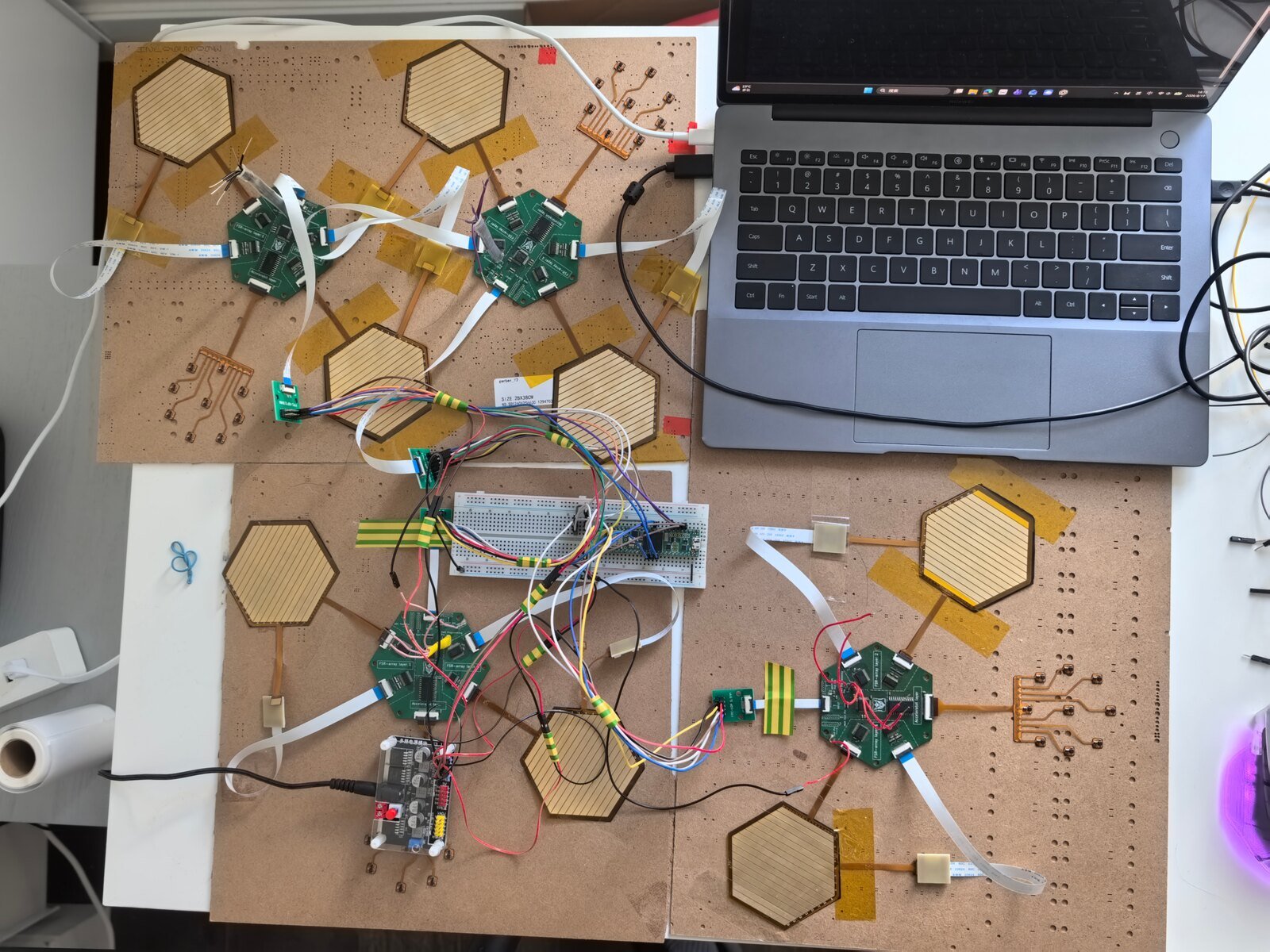
A four-module prototype, each hexagonal module carrying two pressure-sensing layers and an accelerometer on its own small controller, chained to a host over a serial bus. Two transmission modes were compared: sending every reading, and sending only what changed. Power was measured module by module, and a calibration procedure was applied layer-wide rather than cell by cell.
What was found
Sending only changes cut the bytes on the bus by roughly two thirds to nine tenths depending on how much was happening on the skin. With the measured traffic model, the host link supports on the order of a few hundred modules at 200 Hz before the bus saturates, and the current draw grows roughly additively with module count. Layer-wide calibration reproduced applied loads to within about 10 %. Everything past four modules is a projection, and the report says so; the transient power behaviour and cross-module calibration are the next measurements to make.