The question
Playing well means choosing the right finger, not only the right key, yet screens and sounds only ever show the key. Recorded performances have the same blind spot: MIDI logs the key and the timing but not the finger. Can a vibration on the nail of the intended finger guide fingering better than a visual cue, and can the same setup let a remote teacher guide a student?
What was built
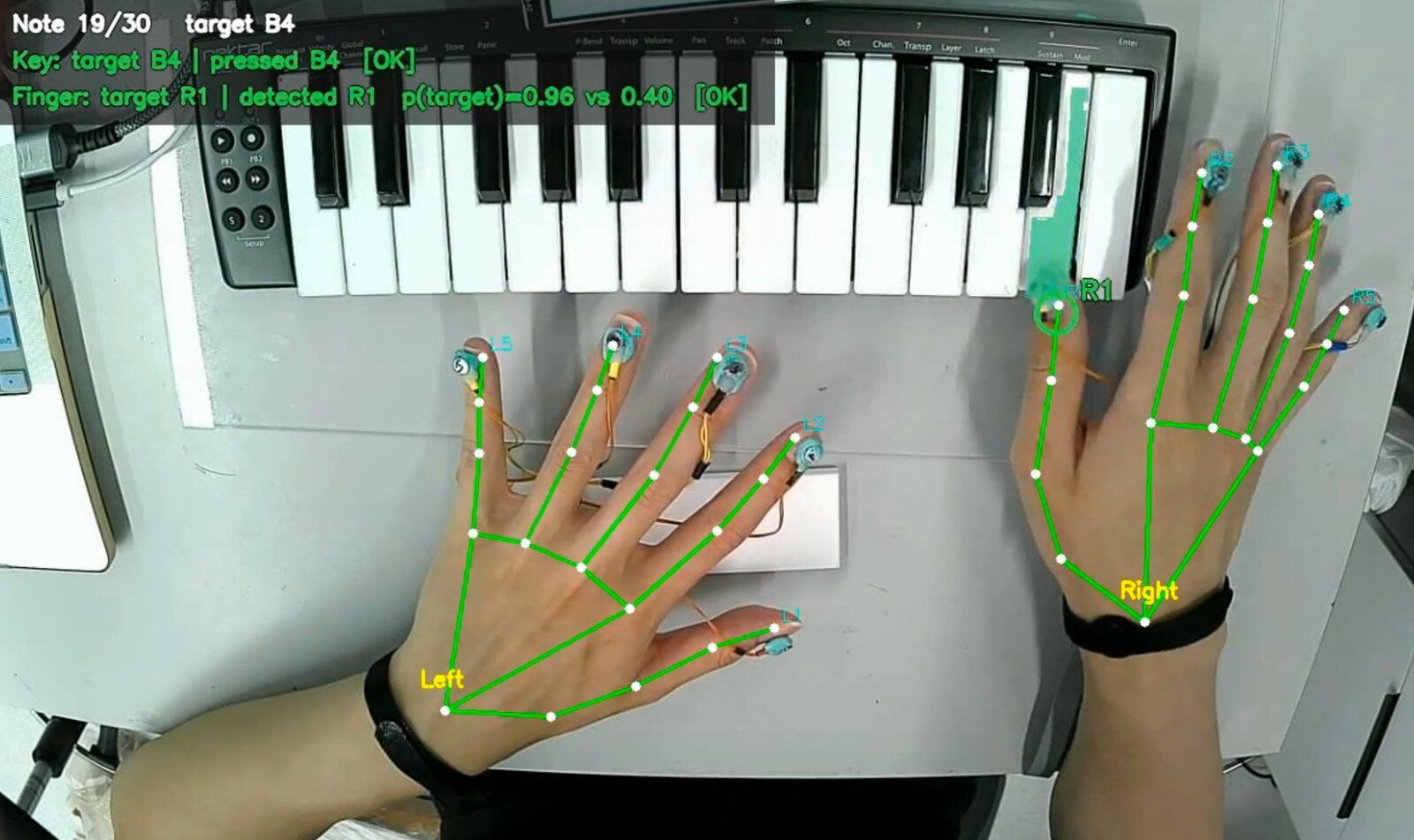
A keyboard with per-key lighting, nail-mounted vibration on each finger, and a camera that identifies which finger actually played each note, aligned to the MIDI stream. Twenty participants played generated sequences of graded difficulty with key-only, visual-finger and vibrotactile-finger guidance. The same finger-and-key representation drove a working remote-teaching link for live and recorded guidance.
What was found
Against matched visual cues, vibration on the nail cut reaction time by about a quarter of a second and raised complete-action accuracy. Wrong-hand errors fell from 29 % to 3 % of substitutions, while key accuracy stayed near ceiling in both conditions. The pattern points to reduced finger-selection effort. Whether the benefit survives once the cues are removed, and how it plays out in remote lessons, is the follow-up work.