The question
Putting the actuator on the fingernail keeps the fingerpad in direct contact with the screen, but nobody had established whether nail-side vibration can render texture convincingly. This project built the system and measured it, first electromechanically, then perceptually, before asking the rendering question.
What was built
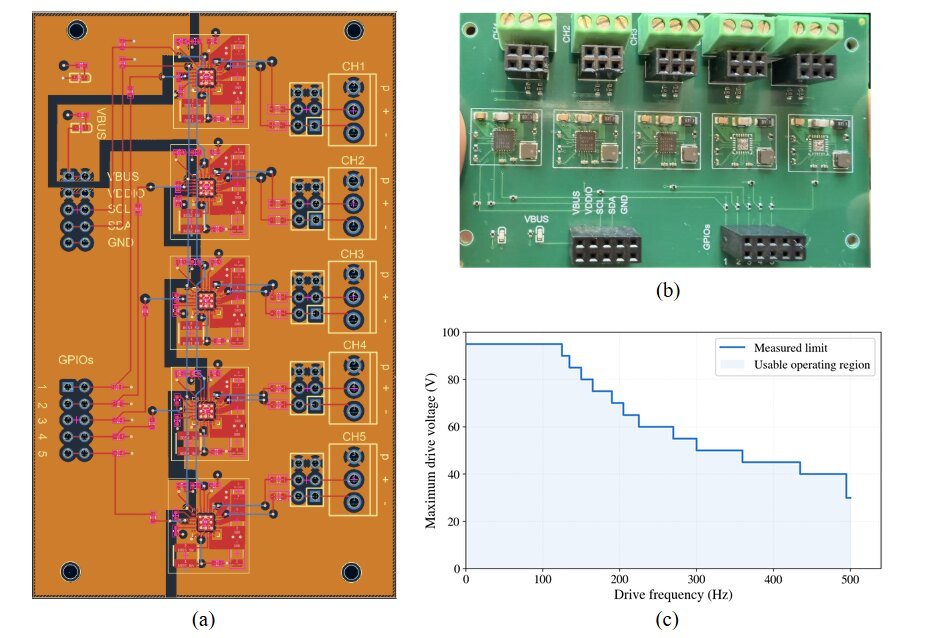
A fingernail-mounted piezoelectric actuator driven by a custom five-channel high-voltage board, characterised across drive frequency, voltage, added mass and finger pressure. Real materials were probed with an accelerometer to record their vibration signature, and each rendered texture received its own spatial pattern and drive parameters derived from those recordings. Ten participants explored six real materials and tried to match them to their rendered versions.
What was found
The real materials were told apart by touch alone 90 % of the time. Matching a real material to its rendering rose from 24 % with one-size-fits-all pulses to 43 % with material-specific parameters, and nine of the ten participants improved. Rendering texture this way is feasible, but only when the spatial pattern, the pulse parameters, the mounting and the finger's contact with the surface are designed together.